Exhibition
Degradê
4 July 2026 — 12 September 2026
Location
- Galeria Quadrado Azul - Porto (Espaço Q1 - nº435)
Titania Seidl | Willem Weismann | Bruno Pacheco
“Degradê” is an exhibition built around a simple yet profoundly fertile principle: the idea of transition. Not the chromatic transition the term usually evokes, but a structural, narrative, and perceptual transition — the space where an image stops being one thing and begins to become another.
Bringing together works by Titania Seidl, Willem Weismann, and Bruno Pacheco, the exhibition proposes a shared territory: painting as a field of instability. Here, each artist works within the interval, the slip, the hesitation — that which is neither fully visible nor fully abstract; that which lives in between.
Painting as a constellation of transitions
Titania Seidl
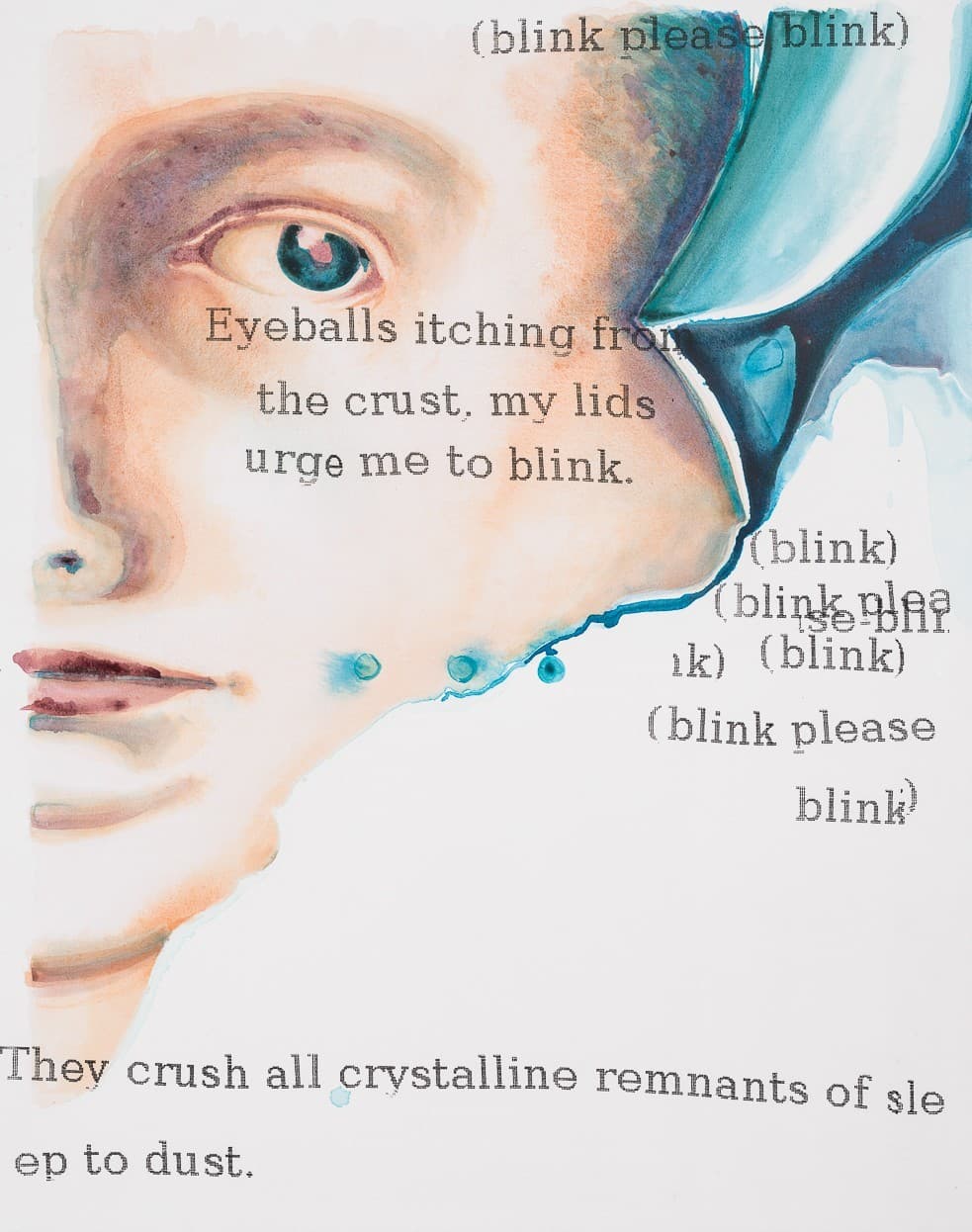
In Titania Seidl’s works, the image appears in fragments. Small paintings grouped together form constellations of gestures, plants, hands, and objects that never settle into a single narrative. They are fragments that breathe, that insinuate themselves, that remain suspended. The artist operates in the degradê between the visible and the imagined, between memory and fiction, between image and text — the latter functioning as an atmospheric layer that contaminates the reading without explaining it. Seidl’s painting is always an interval, a slide, a zone where figuration dissolves and reappears in intermediate states.
Willem Weismann
Willem Weismann dismantles visual systems to reveal the instability that inhabits them. His paintings composed of accumulated strata — almost geological, almost sculptural — expose an internal logic made of rules, repetitions, and failures. Order is never stable; the system contains its own sabotage. In his interior scenes, the everyday is shifted into a regime of subtle strangeness: reclining figures under artificial light, familiar objects vibrating with unreal colour, atmospheres oscillating between domestic and theatrical. Weismann works in the degradê between structure and chaos, between recognition and absurdity, between the real world and the fiction that destabilises it.
Bruno Pacheco
Bruno Pacheco presents solitary figures in pared down settings — platforms, arches, minimal interiors — that function as mental stages. The human figure emerges as a suspended presence, hesitant, situated between character and symbol. Nothing fully asserts itself; everything remains in process. By repeating and varying compositions, Pacheco reveals the image as attempt, as hypothesis, as a gesture that refuses to fix itself. His painting occupies the degradê between figuration and abstraction, between narrative and silence, between presence and absence.
The point of convergence: the interval as method
Although distinct, the three artists converge on a central point: painting as a space of transition.
• Seidl works the narrative degradê — the interval between fragment and fiction.
• Weismann works the structural degradê — the interval between system and failure.
• Pacheco works the perceptual degradê — the interval between figure and abstraction.
The exhibition does not seek to harmonise these differences; it seeks to make them visible. “Degradê” is the place where each work reveals its own instability, and where that instability becomes a shared language.
Conclusion: degradê as a way of seeing
“Degradê” is not just a title: it is a way of looking. It recognises that the image lives in the interval, in the passage, in the hesitation. It understands that painting remains one of the most powerful means of thinking about what is not yet, but has already begun to be.
In this exhibition, Seidl, Weismann, and Pacheco show that degradê is not an effect: it is a method. It is the place where painting breathes — where the image transforms as it is seen.
July 2026
Gustavo Carneiro
Exhibition photos: Filipe Braga