Exhibition
Globotomy
3 October 2020 — 27 February 2021
Location
- Galeria Quadrado Azul, Lisboa
In his second solo show with
Quadrado Azul Gallery, Rigo 23 presents a series of works executed in a distant
2017. The four artworks were first shown at the Weltkulturen Museum in
Frankfurt, and at Millennium Gallery, Lisbon, then Ibero-American Cultural
Capital.
During the two-person show in
Frankfurt with Brazilian artist Ayrson Heráclito, the exhibition’s title was Entre Terra e Mar - Between Land and Sea -
Transatlantic Art; and in Lisbon’s touristic center it was Itacoatiara[i][1].
Now, in 2020 at Quadrado Azul Gallery, located between the Júlio de Matos
Psychiatric Hospital and Padre António Vieira School, the exhibition assumes
the title Globotomy.
Rigo’ s work challenges the idea of
art being insulated from its surrounding context; it pushes against the notion
of art as phenomena which is easily isolated, catalogued, collected, priced,
presented and preserved between walls and pages. For over three decades now, Rigo’ s artistic
production rarely occupies the same territory, its untidiness reflective of a
disordered search rooted in the vertigo of the abyss. Born on Madeira Island,
the artist has spent the majority of his adult life in the Far West’s fascinating
dystopia - in dialogue with Indigenous and Black experiences. In this
exhibition, he presents works produced in close collaboration with communities
and individuals from a Far West much less travelled by European curiosity - the
Southern hemisphere’ s, with which Portugal’s history is entwined and indebted.
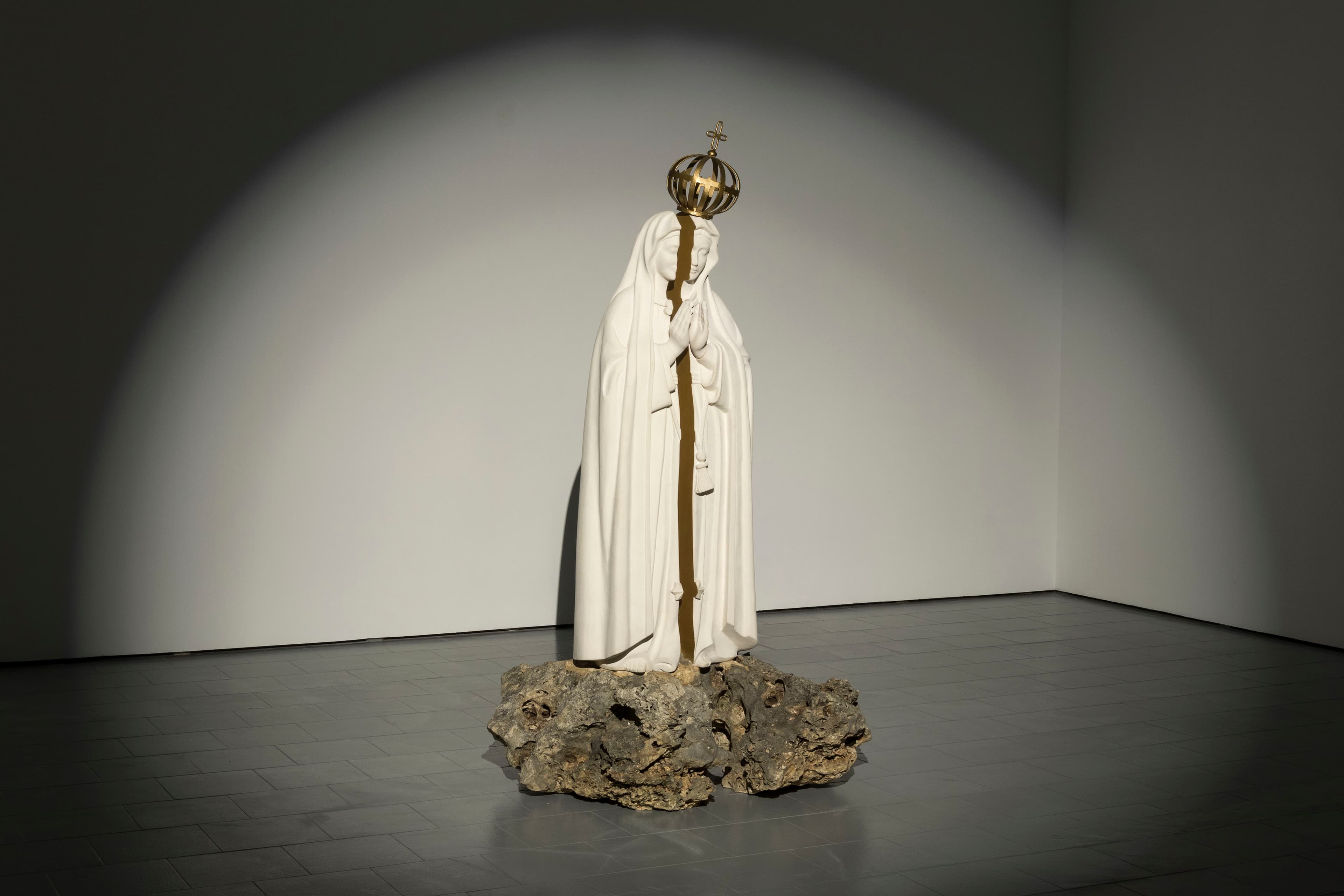
The exhibition includes four works: a
video which resulted from an action carried out by members of three Guarani
Villages on a Cardoso Island beach, today known as Itacuruça[2]
- in the Southern region of the state of São Paulo, Brazil; a stone sculpture
representative of a sacred territory trespassed by a border; a bamboo encasing with wood and found
materials from the beaches of Cardoso Island, in route to Itacuruça; and a
drawing in Indian ink and embroidery charting a Guarani scream through European
territory in 2017.
[1] Colored
stone, in Guaraní, the first designation given by the Guarani to the
painted stone marker that a Portuguese expedition placed in 1502 on their
territory defining a point on the border created by the Treaty of Tordesillas
in 1494.
[2] Stone
cross in Guarani, and today’s name of the beach where the marker was placed
in 1502 designating a point on the border created by the Treaty of Tordesillas.